
Failure in Writing: The Path to Growth
On being a "recovering perfectionist" and tips from author Stephen Marche

I have a theory about procrastination.
First some background: Over the past week or two, I’ve been in the midst of of interviews and rough edits for the next season of my podcast, The Book I Had to Write.
I’m excited about these episodes, which will be out before the end of the year. These include interviews with:
Jeannine Ouelletteon the importance of “nimbleness, improvisation and the absolute necessity of mistakes”;
Melissa Petroon her forthcoming book on shame and about what it takes to sell a nonfiction book today;
Margo Steines on her essay collection Brutalities and how to write about trauma without retraumitzing yourself;
Plus a couple more guests TBA.
But with the work of pulling the show together, writing this weekly Substack, and a busy time at my day job…I found myself last week hitting a wall.
Some of it was simply that I had yet to realize I was taking on too much and that something might have to give.
But lurking behind the stress was the temptation to procrastinate. To simply throw in the towel. I couldn’t help thinking: Things would be a lot easier if I just didn’t have to show up to do any of this.
I’ve come to see that there’s a real logic to this type of procrastination. It makes sense when you think about it. Your brain says: why bother doing any of these tasks since you’re probably going to do a lousy job at all of them.
Procrastination was a habit or “character defect” I used a lot when I was younger. Like all bad habits, it started off in small ways…leaving grade school assignments till the last possible moment, for example. It got particularly bad at university, so much so that by the time I graduated—a year after I was supposed to—I’d taken incompletes in a quarter of all my classes.
The fact I didn’t procrastinate much this past week—that I could step back from the ledge and actually write this week’s newsletter—is more a function of the many years I’ve spent understanding the underlying fears and working on better coping mechanisms.
Just this week, in our interview, Jeannine Ouellette called herself a “recovering perfectionist.”
I have to say, the instant she said that, I felt myself blush in self-recognition.
For me, overcoming procrastination is the work of a lifetime.
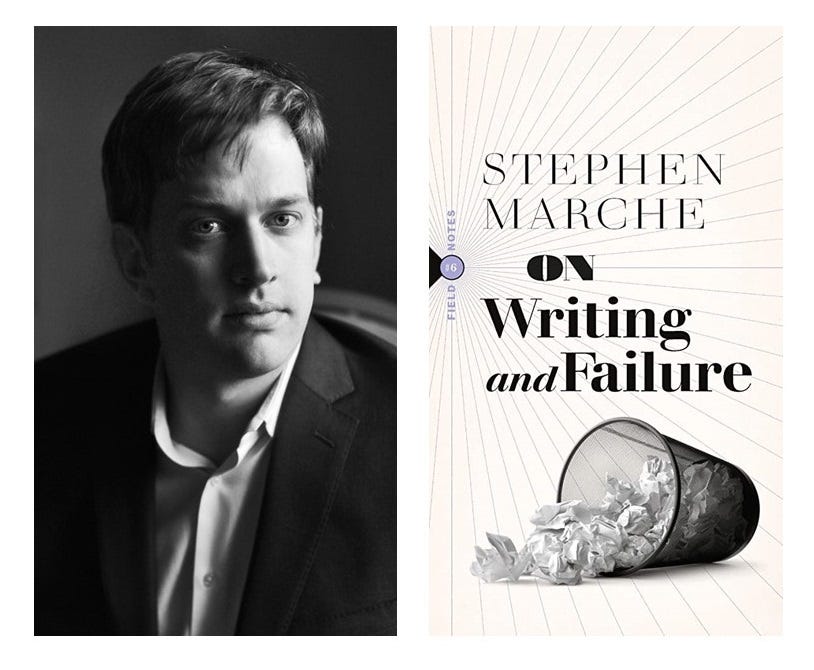
All of this may be one reason why I found myself thinking back to the podcast episode I’d done earlier this year with the writer and critic Stephen Marche.
He’s a Toronto-based columnist for Esquire and the author of five books including The Next Civil War: Dispatches from an American Future and How Shakespeare Changed Everything.
Much of Stephen’s most recent book, On Writing and Failure, actually deals with what I’m going to call external failures for writers: namely the challenge of making a living from writing these days—because of the decline of institutions including academia, the humanities, book sales, or journalism; but also because we’re in the midst of an enormous technological upheaval.
“…I think the last time it was really like this was the jump from patronage to professionalism in the late 18th century where there was a gap of about 40 years where, basically, no writer could make a living,” he says.
Listen here:
But as Einstein said (apocryphally) “in the midst of every crisis lies great opportunity.” If the rise of the internet has accelerated the decline of print and the instability of online publications, then Marche’s advice for writers is to recognize this transitional stage and adapt to the changing landscape.
Marche, who earned a Ph.D. in early modern English drama and whose references tend to evoke major literary figures of the past, cites the example of Samuel Johnson as a model for how working writers can reimagine how to continue writing despite all the headwinds writers face:
To me, [Samuel Johnson] was very much a recognizable figure in that he's out there doing everything…he's judging poetry contests, he's translating Latin poetry, he's writing his own occasional verse for the magazines, he's hustling…he's telling life stories of hookers, he's writing life stories of other writers, he's editing Shakespeare. He's just doing everything of every level that could possibly pay him money…It was a definite struggle.
So the importance of versatility—and the model of a writer as someone who is willing to wear a lot of hats—is one lesson I took away from Stephen’s book.
Failure as part of the writing process
In our interview, Stephen and I also talked about at least a couple of ways of wrestling with what I’m calling interior examples failure.
The biggest of these failures may be simply the fact we’re all walking around imprisoned in our consciousnesses, and there’s a limit to how far we can bridge the space between two people:
I think you have the sort of deeper failure of writing, which is the most profound aspect of it, which is the way you're trying to communicate between your privacy, your private language, and communicate that to another privacy in another time, in another language, in another place, in another person's private life in their own person.
Listen:
AND THERE you have it… a book that wants to make the point that failure is inherent to the writing life; that it is failure, not success, that writers should strive for; and that by embracing failure we’re not accepting it as a moral judgment or character designation, but simply a byproduct of adhering to the writing life.
On Writing and Failure grew out of a “commonplace book” that Stephen kept for years, where he recorded stories of failure…which to him were more inspiring, rang truer to the writing life, than success stories. (For more on commonplace books and other types of writer notebooks, check out Jillian Hess’s brilliant newsletter Noted).
As for me, part of the recovery from procrastination has to do with short-circuiting my own fear of failure, of showing up as less than perfect. Sometimes that work will be better than at other times.
Which to me sounds like a type of success.
Listen to the full episode here.
I LOVE HEARING FROM YOU!
If you’ve read this post and you have something smarty-pants or just kind to say, please consider leaving a comment below!
Ooo--how wonderful that Stephen's On Writing and Failure came out of a commonplace book! I assume most writing does...but it's cool to hear it acknowledged!
This is great, Paul. I love the this emphasis on the book we *want* to write, too, because that's exactly where I am right now, and happy to be here. Thanks for this wisdom.